
In this article:
Enabling Privacy Rights in your Privacy Center
Navigate to the ‘DSR setup’ page to see which privacy rights are available in your Privacy Center.
Use the toggle buttons to enable or disable rights in your Privacy Center, or click the ‘New right’ button to create additional rights.
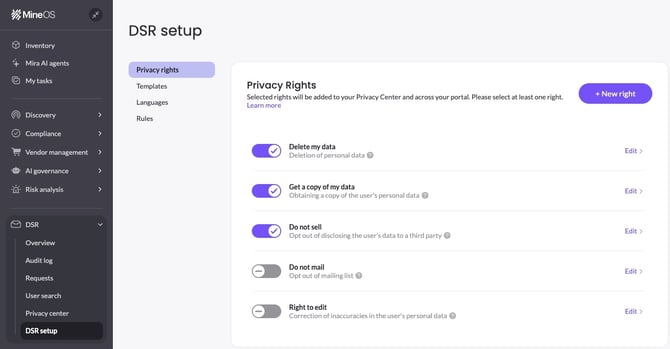
Note: At least one privacy right must remain enabled at all times. If you try to disable the only active right, you'll see a tooltip: "You must have at least 1 right enabled." To disable it, first enable a different right, then you can turn off the original one.
.jpeg?width=670&height=350&name=Image%2003-02-2026%20at%2013.26%20(1).jpeg)
Adding New Rights
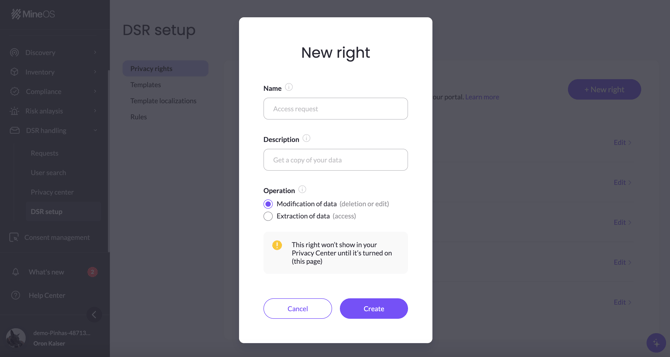
When creating a new right, you’ll need to define the following:
- Name: The right's name, as it will appear in your Privacy Center
- Description: The right's description, as it will appear in your Privacy Center
- Operation type: This choice will affect the actions the integrations perform.
- Select ‘Modification of data’ for rights such as Deletion, Edit or Do not sell (unsubscribe), where data will be manipulated or deleted in third-party apps.
- Select ‘Extraction of data’ for all other types of rights, such as Access.
Configuring Privacy Rights
Click the ‘Edit’ button next to the right you’d like to configure.
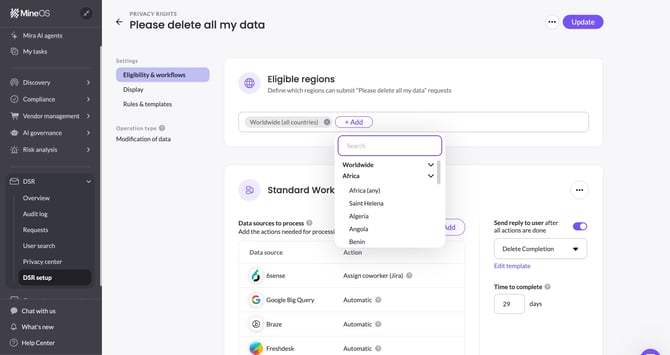
Configuring eligible regions
Use this section to limit submissions of this right to specific countries or states. When a data subject opens your Privacy Center and selects their country, only the rights that are eligible for that country will be displayed. If a right has no eligible region configured for the data subject's country, it will be hidden from the Privacy Center entirely — meaning the data subject won't see it as an option at all. Eligible regions are configured at the right level and apply across all workflows defined for that right.
For certain countries, such as the United States, eligibility can be defined at the state level rather than the country level — allowing you to surface a right only to data subjects in specific states (e.g., California or Texas).
Managing workflows
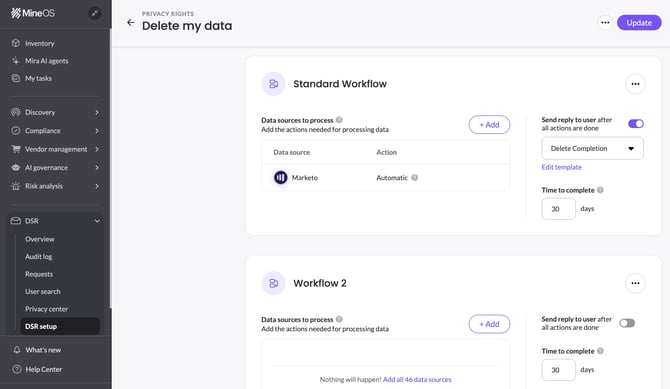
A workflow defines which systems are processed when a request is submitted, the email template sent to the data subject upon completion, and the SLA for handling the request. Having multiple workflows under a single right allows you to handle different types of data subjects appropriately — for example, processing an employee's deletion request through HR and internal systems, while routing a customer's request through CRM and marketing tools, each with its own timeline and communication.
By default, requests will be assigned the 'Standard Workflow,' which defines the systems to be processed for the request, as well as the default email template sent upon completion. Click 'Add another workflow' to create additional workflows that agents can select on the request page (e.g., Clients workflow or Candidates workflow).
Changing the workflow from the UI Once a ticket is open, agents can change its assigned workflow directly from the request page — as long as processing has not yet started. Click the arrow next to the workflow name under the Workflow section at the top of the ticket. If additional workflows have been defined for that right, they will all appear in the dropdown for selection.
Changing the workflow via API It is also possible to change the assigned workflow programmatically using the Change workflow endpoint. Note that this is only allowed while the ticket has not yet started processing. If the requested workflow is already assigned to the ticket, the call will return 200 with no side effects.
Defining the workflow when opening a request via the API is done via the Create request endpoint, by passing the workflowId in the request body — allowing for automated routing based on your own logic.
To retrieve the workflow currently assigned to a ticket, there are two options. The Get ticket endpoint returns the full ticket details, including workflowId and workflowName as part of the payload. Alternatively, the dedicated Get workflow endpoint returns a more focused response with the workflow ID, display name, and the full list of integrations attached to the ticket's workflow — useful when you only need workflow-specific information without fetching the entire ticket.
When using the List all requests endpoint to query tickets in bulk, each ticket in the response also includes workflowId and workflowName, making it easy to filter or group tickets by workflow.
To find the available workflow IDs for each right, use the Get privacy rights endpoint. The response includes a workflows array for each right, containing the workflowId, workflowName, and an isDefault flag indicating which workflow is the default.
Define additional rules
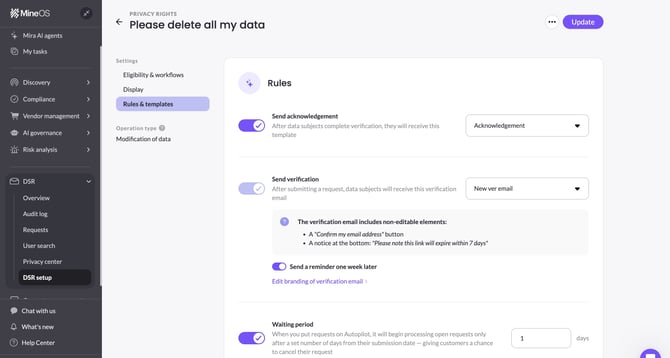
Navigate to the Rules & templates tab within a specific right's menu to configure the following rules:
- Send acknowledgement: Choose the email template that data subjects receive after completing verification
- Verification reminder: By default, a reminder email is sent one week after the initial verification email. Disable this option if you don't want to send a second verification email
- Waiting period: When using Autopilot mode, set the number of days to wait before processing requests. This grace period allows customers to cancel their request before it's automatically processed
- Rejection template: Select the email template to use when rejecting requests
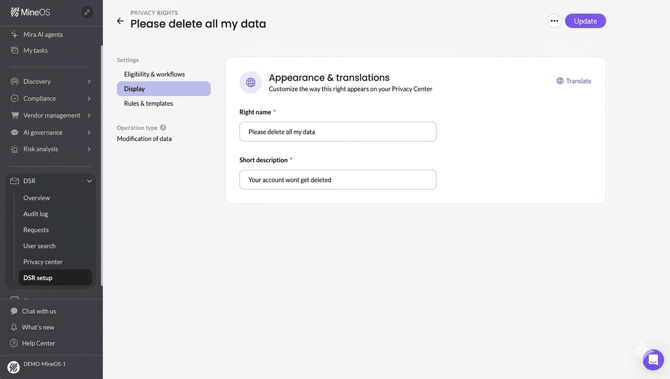
Right display name and description
If needed, navigate to the Display tab in each right's sidebar to update the right's name and description as they appear in your Privacy Center. Note that each right's name and description is managed separately.
To manage translations, click the Translate button on the right side of the screen to open the translation panel. The languages listed in the panel are the languages configured under DSR setup → Languages. All languages are pre-populated with default translations.
Translation panel:
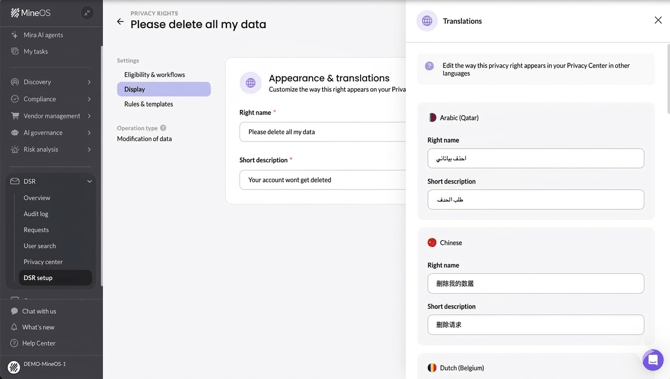
Note: If you update the English name or description, you will need to manually update all translations accordingly, as the pre-populated translations are based on the original default English text.
Need Help?
If you have questions about managing privacy rights, contact your system administrator or reach out to your MineOS CSM.