
What is DSR Autopilot?
DSR Autopilot lets you automatically process Data Subject Requests (DSRs) from start to finish. The DSR handling workflow consists of 5 steps: Review, Process, Reply, Close, and Redact. Autopilot removes the need to click through each step or wait for processing to complete by automating the entire flow.
How Autopilot works?
When you assign a ticket to Autopilot, MineOS handles all five steps of the DSR workflow automatically:
- Review — The ticket is verified, qualified for Autopilot, and assigned to begin automated processing.
- Process — All automated integrations in the ticket's workflow are executed.
- Reply — The requester is sent a completion email based on the workflow's reply template.
- Close — The ticket is closed once all integrations are complete and the reply has been sent.
- Redact — The ticket is scheduled for automatic redaction to remove the requester's personal data from the system.
Eligibility requirements
A ticket can run on Autopilot only when:
- The ticket is open (Autopilot cannot run on closed, unverified, redacting, or redacted tickets)
- The ticket's workflow contains no manual tasks and no assign coworker flow — all steps must be automated integrations
If a ticket doesn't meet these conditions, the Put on Autopilot button will appear in a disabled state on the ticket page.
Assigning Autopilot to a single ticket
To run autopilot on a single ticket, follow these steps:
-
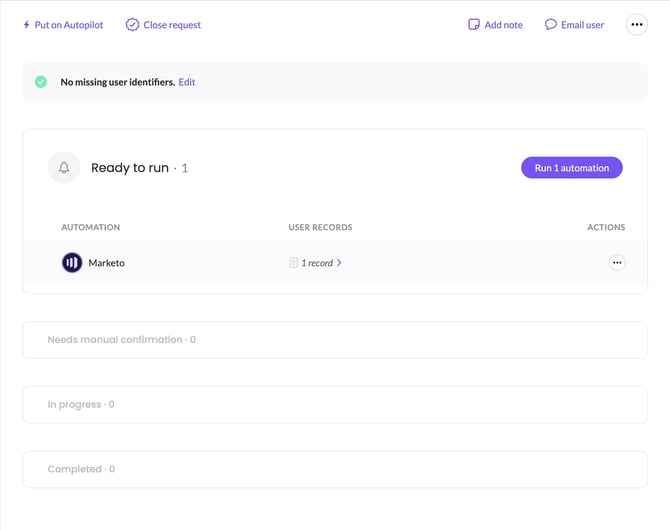
Enter a specific request
- Click on the "Put on Autopilot" button on the top left side of the screen (the button is enabled only for requests that are valid for Autopilot).
- Confirm assigning the request to Autopilot by clicking "Confirm" in the dialog box
- Autopilot starts running the request, the Autopilot indication banner will change to "Autopilot is handling this request".
 Assigning Autopilot to multiple tickets at once
From the Requests table, select all the tickets you want to run via Autopilot, then click Put on Autopilot in the bottom action bar:
-
Go to the Requests table page
-
Toggle the checkboxes of the requests that you wish to run Autopilot on
-
Click "Put on Autopilot" button on the right-lower side of the screen
- Validation step: checks if each ticket can be assigned to Autopilot, if not, you will get an indication how may tickets where assigned to Autopilot.
- Once tickets are assigned to Autopilot, a blue icon will appear next to the Request status. (Note: you can still view and handle the ticket manually, if needed).
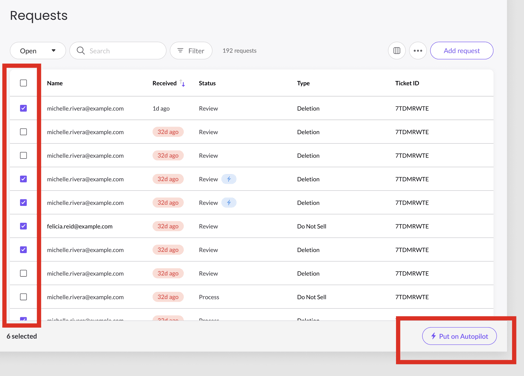
Tip: use the filters to select tickets for autopilot using bulk action. For example: ticket type = delete, and country = United States
Note: If any selected tickets are ineligible (e.g., they contain manual tasks), those will return an error while the remaining eligible tickets are successfully assigned to Autopilot. An Autopilot icon will appear next to each successfully assigned ticket in the table.
Automatically starting Autopilot on all incoming requests
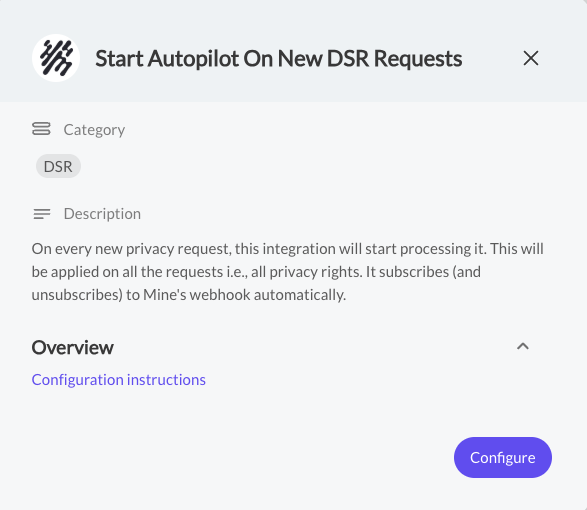
If you want every new privacy request to be processed by Autopilot automatically — across all privacy rights — you can use the Start Autopilot On New DSR Requests sutomation, available in the MineOS marketplace. Reach out to your customer success manager and they will help you set up the automation.
This integration listens for new incoming requests via webhook and triggers Autopilot on each one as it arrives. It manages its own webhook subscription automatically, so no manual webhook configuration is needed.
To set it up:
- Go to Settings > Automations > Marketplace and pick the Start Autopilot On New DSR Requests integration.
- Click Configure
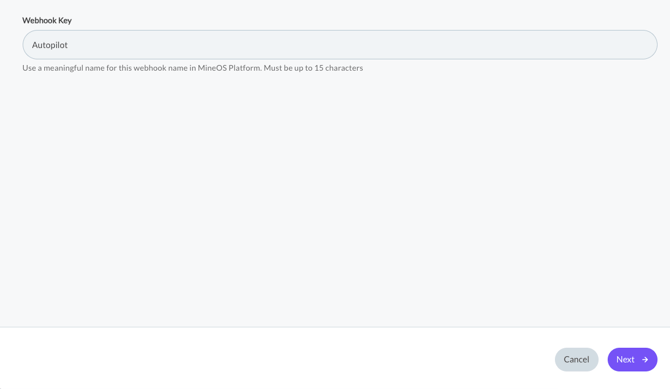
- Edit the webhook id if you prefer. We recommend on leaving it as is
- Click Finish
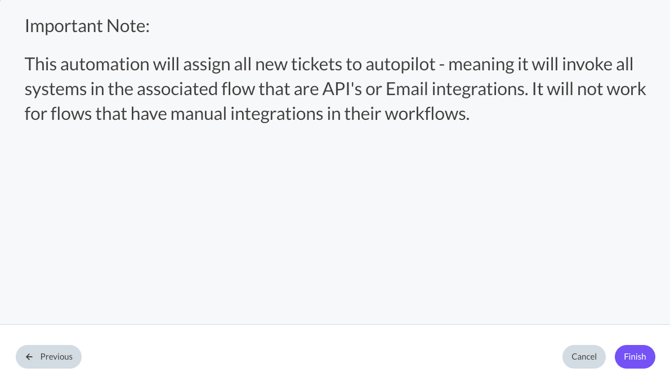
- That's it! You'll see a green indicator on the integration in the marketplace now. Once active, every new eligible request will be automatically assigned to Autopilot.
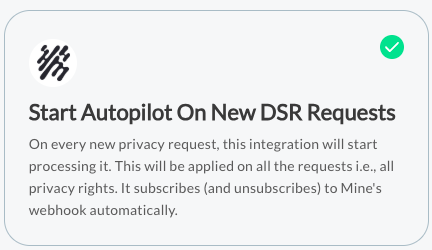
Keep in mind: This applies to all privacy rights. Any ticket that doesn't meet Autopilot's eligibility requirements (e.g., contains manual tasks) will not be processed automatically and will remain in your queue for manual handling.
The waiting period
You can configure a waiting period per privacy right before Autopilot begins the Process step. This is set under DSR Setup → Privacy Rights → General → Rules.
During the waiting period, the ticket enters a Pending state and shows a countdown to when processing will begin. You can cancel Autopilot at any point during this period, which returns the ticket to its previous state.
Note: If at the time of assigning Autopilot, a ticket was open longer than the waiting period duration it will skip the Pending state and go directly into processing.
Processing timelines
After all integrations complete, Autopilot schedules the Reply and Close steps with a short delay to allow confirmations to finalize:
- Data Mutation requests: approximately 60 minutes after integrations complete
- Data Collection requests: approximately 5 minutes after integrations complete
Automatic retries
If an integration fails during the Process step, MineOS will automatically retry the entire ticket. This happens up to 3 times. If all retries are exhausted, your team will be notified via your configured Slack notification integration (if set up), and the ticket will require manual review.
Autopilot and Required Attention Flag
The Required Attention flag signals that a ticket needs human review before processing continues. It works as a supervision mechanism — when active, it means someone needs to check or do something manually before the ticket moves forward.
Assigning Autopilot to a flagged ticket: You can assign Autopilot to a ticket that is marked as Required Attention. Autopilot will be assigned successfully, but will not begin processing until the flag is removed. Once you mark the ticket as reviewed and clear the flag, Autopilot will start automatically.
Flagging a ticket that is already on Autopilot: If a ticket is already being processed by Autopilot, marking it as Required Attention will pause Autopilot before it moves to the next step. Any integrations that are already running at the time of flagging will continue to completion — the flag only prevents Autopilot from advancing further. Once you remove the flag by marking the ticket as reviewed, Autopilot resumes from where it paused.
Current limitations
- Tickets with manual tasks in their workflow cannot run on Autopilot.
- If any single integration fails during processing, all integrations are retried together — there is no partial retry.
- Autopilot does not prevent other actions from running on the ticket in parallel. Performing manual operations on a ticket while Autopilot is running (such as closing it via API) may interrupt the process.
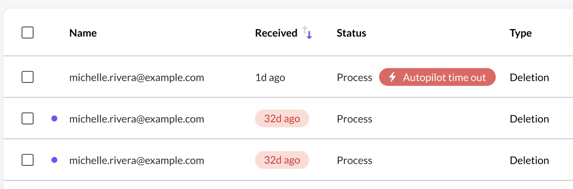
- Autopilot will fail handling integrations that take more than 3 days to complete or has run out of retries on automated integrations. An icon will appear next to the status to indicate autopilot has stopped running. You can then continue handling the request manually.
Is Autopilot right for me?
You should not use Autopilot if you:
- Manually communicate with customers or manage notes
- Want to choose from which sources to delete and which not, depending on the request
- Have manual integrations